AFCAT 02/2026 Recruitment 2026
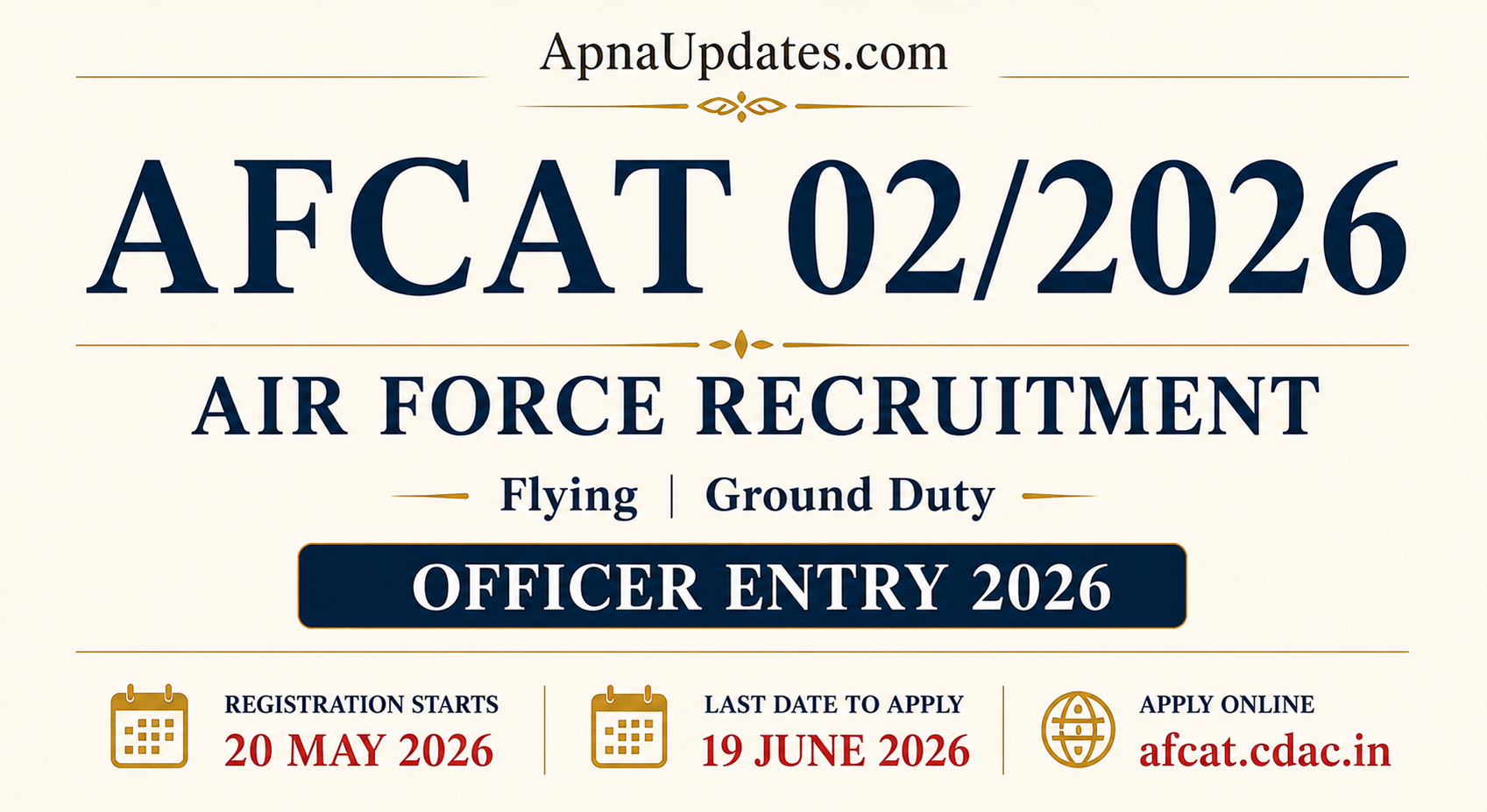
⚠️ Air Force AFCAT 02/2026 Recruitment 2026: Exam Result & Scorecard Released
The Indian Air Force (IAF) has released the AFCAT 02/2026 written examination result. Candidates who appeared for the AFCAT 02/2026 examination can now check their individual result and scorecard through the official candidate login portal. The result has been released on 09 September 2026.
> Candidates can log in using their registered email ID and password to check their qualification status, marks and other result-related details. Candidates who qualify in the written examination will proceed to the AFSB selection stage as per the applicable selection process. Candidates should download and save their result/scorecard for future reference and check the official portal for further instructions regarding the AFSB stage.
⬇️ Scroll down to the Important Links section below where the direct link to check the Air Force AFCAT 02/2026 Exam Result & Score Card has been provided.
-------------------------------------------
The Indian Air Force has released the AFCAT 02/2026 notification. They are currently accepting applications from eligible Indian citizens for both flying and ground duty branches. This is a standard selection process for those looking to serve as commissioned officers.
Candidates can apply for Permanent Commission (PC) or Short Service Commission (SSC) based on the available branches and their qualifications. The courses for this batch are scheduled to begin in July 2027, with training conducted at the Air Force Academy located in Dundigal, Hyderabad.
Quick Overview
| Particulars | Details |
|---|---|
| Organization Name | Indian Air Force (IAF) |
| Post Names | Flying Branch, Ground Duty (Technical), Ground Duty (Non-Technical) |
| Total Vacancies | 379 (Men & Women) |
| Application Mode | Online |
| Registration Start Date | 20 May 2026 (11:00 Hrs) |
| Last Date to Apply | 21 June 2026 (23:30 Hrs) (Extended) |
| Training Location | Air Force Academy, Dundigal (Hyderabad) |
| Job Location | Across India |
| Starting Pay | Rs. 56,100/- (Level 10) + MSP Rs. 15,500/- |
| Official Website | https://afcat.cdac.in |
Detailed Vacancy Breakdown
The notification outlines vacancies across multiple branches and commission types. Here's what you need to understand:
| Branch | Entry Type / Post | Men (PC) | Women (PC) | Men (SSC) | Women (SSC) |
|---|---|---|---|---|---|
| Flying | AFCAT Entry | - | - | 30 | 05 |
| Flying | NCC Special Entry | 10% | - | 10% | 10% |
| Ground Duty(Technical) | AE(L) - AFCAT | 02 | 02 | 107 | 25 |
| Ground Duty(Technical) | AE(M) - AFCAT | 08 | 02 | 52 | 13 |
| Ground Duty(Technical) | AE(L) - GATE | 01 | 01 | 12 | 03 |
| Ground Duty (Technical) | AE(M) - GATE | 01 | 01 | 06 | 01 |
| Ground Duty(Non-Tech) | Weapon System | - | - | 21 | 05 |
| Ground Duty(Non-Tech) | Administration | - | - | 50 | 12 |
| Ground Duty(Non-Tech) | Logistics | - | - | 04 | 02 |
| Ground Duty(Non-Tech) | Accounts | - | - | 05 | 02 |
| Ground Duty(Non-Tech) | Education | - | - | 07 | 02 |
| Ground Duty(Non-Tech) | Meteorology | - | - | 01 | 02 |
Eligibility Criteria
The educational requirements vary significantly based on the branch you're applying for:
For Flying Branch:
AFCAT Entry & NCC Special Entry:
Graduation degree (minimum three years) in any discipline from a recognized university
Minimum 60% marks in graduation (for all stages of education if it's a multistage degree)
Alternatively, candidates holding a valid and current Commercial Pilot License issued by DGCA (India) are also eligible
Key Point: Even if you're from arts, commerce, or science background, you can apply for Flying Branch. The focus is on overall merit, aptitude, and physical fitness rather than technical knowledge.
For Ground Duty (Technical) Branch:
Through AFCAT:
Four-year engineering degree (BE/B.Tech) from a recognized university or institution
Minimum 60% marks in engineering
Branches typically include Aeronautical, Mechanical, Electrical, Electronics, Computer Science, and related disciplines
Through GATE Score Entry:
Four-year engineering degree with valid GATE score
The GATE score provides direct entry without appearing for AFCAT
Minimum 60% marks in engineering
For Ground Duty (Non-Technical) Branch:
Different sub-branches have specific requirements:
Warden Services (WS): Graduation in any discipline with 60% marks
Administration (Admn): Graduation in any discipline with 60% marks
Logistics (Log): Graduation in any discipline with 60% marks
Accounts (Accts): Graduation in Commerce or a degree with Commerce as a subject with 60% marks; OR Post-graduation degree in Commerce with 60% marks; OR Graduate with ICWA/CA qualification
Education (Edu): Post-graduation in any discipline with 60% marks; OR Graduation with B.Ed with 60% marks in both
Meteorology (Met): Graduation in Physics and Mathematics or Computer Science as subjects OR B.E/B.Tech in Computer Science/IT/Electronics with 60% marks
Note: Final year students CANNOT apply - degree must be completed
Age Limit Details
For Flying Branch:
AFCAT Entry & NCC Special Entry:
Minimum Age: 20 years
Maximum Age: 24 years
Age calculation date: 01 July 2027
This means candidates must be born between 02 July 2003 to 01 July 2007 (both dates inclusive)
Special Relaxation for CPL Holders:
If you hold a valid and current Commercial Pilot License issued by DGCA (India), the upper age limit extends to 26 years
Birth date range: 02 July 2001 to 01 July 2007 (both dates inclusive)
For Ground Duty Branches (Technical & Non-Technical):
All entries including AFCAT and GATE Score Entry:
Minimum Age: 20 years
Maximum Age: 26 years
Age calculation date: 01 July 2027
Birth date range: 02 July 2001 to 01 July 2007 (both dates inclusive)
Note: Don't close the browser immediately after payment. In case of payment deduction without application confirmation, wait for 24-48 hours before retrying as multiple payment attempts may lead to duplicate deductions. Lastly keep your transaction ID/reference number savedThere is no age relaxation for reserved categories (SC/ST/OBC) in defence services recruitment
The age is calculated as on the specific cut-off date mentioned - not on the date of application or exam
Even if you're one day over the age limit, your application will be rejected
Application Fee Structure
For AFCAT Entry:
Candidates registering for AFCAT entry need to pay an examination fee:
Amount: Rs. 550/- + GST
Nature: Non-refundable. This fee is for conducting the online examination
Entry through NCC, GATE Score: Exempted from Fee
Payment Mode: Online
Salary and Other Benefits
Basic Pay: Rs. 56,100/- (Pay Level 10 as per 7th CPC)
Military Service Pay (MSP): Rs. 15,500/-
Total Initial Basic + MSP: Rs. 71,600/-
But here's what most candidates don't realize - this is just the foundation. Your actual monthly income will be significantly higher.This varies based on allowances, posting location, and branch
Long-Term Financial Benefits
Promotion Growth: As you progress through the ranks- Flying Officer, Flight Lieutenant, Squadron Leader, Wing Commander, Group Captain, and beyond your pay increases substantially at each level.
Pension (for PC Officers): Permanent Commission officers who complete their required service are entitled to pension benefits, providing financial security after retirement.
Insurance: Mandatory insurance coverage of Rs. 1.25 crore for serving officers, and Rs. 12 lakh insurance coverage payable at age 75 for officers retiring after 20+ years of service.
Selection Process
The selection process for Indian Air Force commissioned officer entries is multi-staged and rigorous. It's designed not just to test your knowledge but to evaluate your overall officer-like qualities, physical fitness, and mental resilience.
Stage 1: Online Examination (AFCAT Only)
For AFCAT Entry candidates: You'll need to appear for an online computer-based test conducted at various centers across India. The exam tests:
General Awareness | Verbal Ability in English | Numerical Ability | Reasoning and Military Aptitude
The exam is conducted online, and you'll receive your result after evaluation. Only candidates who qualify in this written examination proceed to the next stage.
For NCC Special Entry: No AFCAT examination - direct selection for AFSB based on NCC certificates and merit.
For GATE Score Entry: Valid GATE score substitutes the written examination. Your GATE score determines your merit for AFSB call.
Stage 2: Air Force Selection Board (AFSB)
This is an important and challenging stage. Conducted over 5 days at AFSB centers (typically Dehradun, Mysore, or Varanasi), this evaluates your:
Day 1 - Screening Test:
Verbal and Non-Verbal Intelligence Test
Picture Perception and Description Test (PPDT)
Group Discussion
Only those who clear screening proceed to remaining days. About 50% of candidates are screened out here.
Day 2-4 - Psychological Tests, Group Testing, and Interview:
Psychological Tests:
Thematic Apperception Test (TAT), Word Association Test (WAT), Situation, Reaction Test (SRT), Self-Description Test (SD)
These assess your personality, thought process, and officer-like qualities.
Group Testing Officer (GTO) Tasks:
Group Discussion, Group Planning Exercise (GPE), Progressive Group Task (PGT), Half Group Task (HGT), Individual Obstacles, Command Task, Final Group Task (FGT)
These evaluate leadership, teamwork, practical intelligence, and physical courage.
Personal Interview: Conducted by an experienced interviewing officer who assesses your knowledge, awareness, motivation, family background, and overall personality.
Day 5 - Conference: All assessors (psychologist, GTO, interviewing officer) discuss and collectively recommend or reject your candidature.
Exam Pattern and Syllabus (AFCAT Entry)
Exam Pattern
| Particulars | Details |
|---|---|
| Mode | Online Computer-Based Test |
| Duration | 2 hours (120 minutes) |
| Total Questions | 100 |
| Maximum Marks | 300 (3 marks per question) |
| Negative Marking | Yes (1 mark deducted per wrong answer) |
| Language | English |
| Question Type | Multiple Choice Questions (MCQs) |
Section-Wise Distribution
General Awareness (25 questions - 75 marks):
Current Affairs (national and international), History (Indian and World), Geography, Polity and Constitution, Economics, Science and Technology, Sports, Art and Culture, Defense-related topics
Verbal Ability in English (25 questions - 75 marks):
Comprehension passages, Synonyms and Antonyms, Error detection, Sentence completion, Idioms and Phrases, One-word substitution, Para jumbles
Numerical Ability (20 questions - 60 marks):
Arithmetic (percentages, profit-loss, time-distance, ratios), Algebra (basic equations), Geometry and Mensuration, Data Interpretation, Simple and Compound Interest, Averages and Mixtures
Reasoning and Military Aptitude Test (30 questions - 90 marks):
Verbal and Non-Verbal Reasoning, Spatial Ability, Logical Reasoning, Abstract Reasoning, Military Aptitude Questions (judgment, decision-making scenarios)
Scoring Strategy
The negative marking of 1 mark per wrong answer is significant - it means you lose 33.33% of the question's value. Don't attempt questions blindly. Focus on accuracy over attempting all questions. A safe target would be attempting 75-80 questions with 85-90% accuracy rather than attempting all 100 with lower accuracy.
Expected Difficulty Level
The difficulty level is moderate to tough. General Awareness requires extensive reading and current affairs knowledge. Verbal Ability tests good command over English. Numerical Ability is comparable to bank exams but simpler than CAT.
Important Topics to Prioritise
General Awareness:
Last 6 months current affairs (national and international), Indian defense developments (recent acquisitions, exercises, technologies), Awards and honors, Books and authors, Important days and events, Basic history (freedom struggle, important movements), Indian geography (rivers, mountains, states, capitals)
Verbal Ability:
Focus heavily on comprehension - it carries significant weightage, Build vocabulary through daily reading, and Practice error detection and sentence improvement regularly
Numerical Ability:
Time-speed-distance problems, Percentage and ratio-based questions, Data interpretation (tables, charts, graphs), Number series and patterns
Reasoning:
Coding-decoding, Blood relations, Seating arrangements, Syllogisms, Military aptitude scenario-based questions (these are unique to AFCAT)
Preparation Strategy
For Complete Beginners
Month 1: Foundation Building
Start with understanding the exam pattern completely. Download and thoroughly read the official notification. Collect previous years' AFCAT question papers (available online through various defense preparation portals). Begin daily newspaper reading - preferably The Hindu or Indian Express. Make notes of important current affairs daily. This habit will serve you throughout the preparation. For Numerical Ability, if your basics are weak, start with Class 9-10 NCERT math books to build foundation. Then move to competitive exam books.
Month 2: Subject-Wise Preparation
Dedicate specific days to specific subjects. For example:
Monday & Thursday: General Awareness + Current Affairs
Tuesday & Friday: Verbal Ability + Reading Comprehension
Wednesday & Saturday: Numerical Ability
Sunday: Reasoning + Mock Tests
This structured approach prevents overlapping and ensures comprehensive coverage.
Month 3: Practice and Revision
Increase mock test frequency. Attempt at least one full-length mock every week. Analyze mistakes thoroughly. Don't just check answers understand why you went wrong and how to avoid it next time. Revise current affairs notes. Update with latest happenings. Create flashcards for important dates, awards, books, appointments.
Study Material Recommendations
Books:
Pathfinder for AFCAT by Arihant Publications
AFCAT (Air Force Common Admission Test) by Ramesh Publishing House
General Knowledge 2025 by Manorama or Arihant
Verbal and Non-Verbal Reasoning by R.S. Aggarwal
Quantitative Aptitude by R.S. Aggarwal or Arun Sharma
Online Resources:
AFCAT official website for previous notifications and exam updates
Defence preparation YouTube channels for free video lectures
Current affairs apps like Gradeup, BYJU's Exam Prep
Mock test platforms offering AFCAT-specific tests
For GATE Score Entry Candidates
If you're applying through GATE score entry, your preparation shifts entirely toward AFSB. Since you've already appeared for GATE, use the time before AFSB call to:
Read extensively about IAF history, aircraft, ranks, current developments
Practice PPDT and GTO task scenarios through coaching or YouTube resources
Work on personality development, communication skills, and general awareness
Get physically fit - run, do obstacle course practice if possible
Understand the AFSB process thoroughly by reading experiences of past candidates
For NCC Special Entry Candidates
Your NCC background gives you an advantage in understanding military culture and discipline. However, don't be complacent:
Your NCC certificate gets you exemption from written exam, but AFSB evaluation is the same for everyone
Brush up your knowledge about IAF-specific information
Leverage your NCC experience during interview and GTO tasks
Ensure your NCC certificates are valid and properly attested
Step-by-Step Application Process
Step 1: Visit Official Website
Go to https://afcat.cdac.in on the opening date (20 May 2026, 11:00 AM onward) Look for "AFCAT 02/2026 Registration" or "New Registration" link
Step 2: New Registration
Click on "New Candidate Registration" or similar link Enter basic details: Name, Date of Birth, Email ID, Mobile Number, Security Code Submit to receive Registration Number and Password on your registered email and mobile
Step 3: Login and Fill Personal Details
Use Registration Number and Password to login to the application portal. Enter all personal information such as name, date of birth, Educational Qualification and GATE details carefully.
Step 4: Choose Entry and Branch
Select carefully:
Entry Type: AFCAT / NCC Special Entry / GATE Score Entry
Commission Type: PC (Permanent Commission) / SSC (Short Service Commission)
Branch Preference: Flying / Ground Duty (Technical) / Ground Duty (Non-Technical)
If Ground Duty (Non-Technical), select sub-branch preference order
This is important - double check your choices as changes might not be allowed later
Step 5: Upload Documents
Upload scanned photograph and signature as per specifications:
Upload other certificates as required
Step 6: Preview Application
Carefully preview the entire application form Check every single entry for spelling mistakes, wrong dates, incorrect percentages Verify uploaded documents are clearly visible
Step 7: Payment of Fee
For AFCAT entry candidates, proceed to fee payment Pay Rs. 550/- + GST through available payment modes (Debit Card/Credit Card/Net Banking/UPI) Complete the payment and wait for confirmation
Step 8: Final Submission
After successful payment (for AFCAT) or document verification (for NCC/GATE entries), submit the final application Take multiple printouts of the submitted application form for future reference Save the Registration Number and Password securely
Important Documents Required
Creating a comprehensive checklist ensures you don't miss anything during application or later stages of selection.
For AFSB Interview Stage
When you receive your AFSB call letter, it will specify the required documents. Typically, you should prepare the following:
Personal Documents:
- Original and photocopies of Class 10 certificate.
- Original and photocopies of Class 12 mark sheet and certificate.
- Original and photocopies of all graduation mark sheets and degree certificate.
- If in the final year, a provisional certificate or college bonafide stating the expected date of result.
- Original PAN Card.
- Aadhaar Card (Original and photocopy).
- Recent passport-size photographs (usually 8-10 copies, matching the one uploaded in the application).
You will receive a confirmation via your registered email and mobile number. Please note your Application Number and regularly check your email and the official website for admit card releases and updates.
Eligibility Documents:
- Original category certificate (SC/ST/OBC/EWS) if applicable.
- Income certificate (for EWS).
- Original NCC certificates (for NCC entry).
- Original GATE scorecard (for GATE entry).
- Commercial Pilot License (for CPL holders).
- Any other specific certificates mentioned in your call letter.
Other Important Documents:
- Character certificate from your college or educational institution.
- Domicile certificate.
- Affidavit regarding marital status (unmarried status).
- Self-declaration for tattoos (if applicable).
Tip: Prepare at least 3 sets of self-attested photocopies of all documents. Keep your originals safely in a separate folder.
Common Mistakes Candidates Make
Learning from others' mistakes is smarter than making them yourself. Here are the most common errors candidates make during IAF recruitment:
Application and Documentation
Ensure your personal details, specifically your name and date of birth, exactly match your Class 10 certificate. Use the official conversion formula provided by your university for percentage calculations. Use a permanent email address and phone number for all communications. Always preview your documents after uploading to confirm they are legible, and complete your application well before the final deadline to avoid technical issues.
Exam and AFSB Preparation
The written exam is only the initial stage; prioritize AFSB preparation early. Build physical fitness and keep up with daily current affairs consistently, as cramming is ineffective. Focus on understanding core concepts rather than relying solely on shortcuts. During the AFSB, be authentic; assessors are trained to identify rehearsed answers. In group tasks, participate actively and collaboratively without being overly dominant or passive.
Medical and Joining
Be truthful about your medical history, as health screenings are thorough and discrepancies can lead to disqualification. Focus on long-term fitness rather than drastic measures before the medical exam. If you use corrective lenses, ensure you bring them. Once selected, read your joining instructions carefully to understand all requirements and deadlines, and ensure you are prepared for the commitment before finalizing your acceptance.
Reality Check
Let's discuss some hard truths about joining the Indian Air Force that candidates should know before applying. This isn't to discourage you - it's to ensure you make an informed decision.
Physical Demands
The work isn't a typical 9-to-5 desk job. Even in Ground Duty branches, physical fitness is mandatory. Regular PT (physical training), drills, ceremonial parades, and operational readiness requirements mean you need to maintain fitness throughout your career. For Flying Branch, the physical and mental demands are even higher - handling high-performance aircraft, decision-making under pressure, irregular schedules, and high-stress operations.
Posting and Transfer Reality
You don't choose where you'll be posted. The service decides based on operational requirements. You might be posted in remote locations, border areas, high-altitude stations, or places with extreme climates. Transfers happen every 2-3 years on average. Just when you settle in a place, you might get posted elsewhere. This affects family life, children's education, and social connections.
Service Before Self
The IAF motto "Touch the Sky with Glory" comes with the unspoken commitment of "Service Before Self." Your personal plans often take a backseat to service requirements. Leave can be canceled during operations or emergencies. You might miss family functions, festivals, or important personal events due to duty. The nation's security needs don't align with your personal calendar.
No Marriage During Training
You must be unmarried at the time of joining, and marriage is not permitted during the training period. This rule is strict. If you're in a serious relationship, you need to discuss and plan accordingly with your partner.
Probation and Bond
There's a probation period during and after training. Performance below expectations can lead to termination even after joining. While rare, it's a reality. Though not a monetary bond in most cases, SSC officers commit to serving the initial tenure (10-14 years). You can't just resign midway like a corporate job. Premature resignation involves complex procedures and is generally not encouraged.
Hidden Important Details From Notification
These are some points mentioned in the notification that candidates often overlook:
PAN Card and Bank Account Mandatory: A valid PAN Card is mandatory for the registration process. Additionally, you must hold a bank account in your name only at a nationalized or scheduled bank. Accounts that are joint, held in other names, or maintained in private banks may not be accepted.
Self-Declaration for Tattoos: Tattoos are generally prohibited on visible parts of the body such as the face, neck, and exposed arms or legs. If you have tattoos on permissible areas like the inner forearm or the back of your hands, you are required to submit a signed self-declaration certificate during your medical examination. Exceptions are only made for specific tribal customs.
Drug Testing: There is a zero-tolerance policy regarding narcotics. Possession or use of drugs is strictly prohibited, and you may be tested at any point during your training. Any positive result will lead to the immediate termination of your candidature. Ensure you are completely free from any substance use well before applying.
Related Recruitment Updates
- Indian Navy SSC IT Officer Recruitment 2026
- IAF Group C Recruitment 2026 (47 Vacancies)
- APSC Class-I Home Guard Recruitment 2026
Frequently Asked Questions
Q1: Is this recruitment for permanent posts?
The recruitment offers Permanent Commission (PC) and Short Service Commission (SSC). PC provides service until retirement age. SSC is for a fixed tenure (10–14 years), which may be extended by 4 years. Conversion from SSC to PC is possible based on merit, vacancy availability, and service requirements, but it is not guaranteed.
Q2: Can final year students apply?
No. Final year students awaiting results are not eligible for this recruitment cycle.
Q3: Is work experience mandatory?
No. Fresh graduates without any work experience can apply. There's no minimum work experience requirement for any branch.
Q4: What is the expected competition level?
Very high. Flying Branch sees the maximum competition with selection ratio around 1:500 or lower. Ground Duty branches have slightly better ratios but still highly competitive.
Q5: Is there an interview in the selection process?
Yes. After clearing the written exam (AFCAT) or being shortlisted based on GATE/NCC, you'll attend the Air Force Selection Board (AFSB).
Q6: Can I apply for both Flying and Ground Duty branches?
You can apply for multiple entries (AFCAT, NCC, GATE) if eligible for each. However, within one application, you typically select branch preference. Read the application form carefully - it will specify whether you can select multiple branches or just one.
Q7: What happens if I clear AFCAT but fail medical examination?
If you're recommended by AFSB but declared medically unfit, you will not be selected for that particular cycle.
Q8: Is there negative marking in AFCAT?
Yes. Each correct answer gives 3 marks, and each wrong answer deducts 1 mark. Unattempted questions carry zero marks.
Q9: Can married candidates apply?
No. You must be unmarried at the time of commencement of the course and marriage is not permitted during training.
Q10: How many times can I attempt AFCAT?
There's no specific limit on the number of attempts as long as you're within the age limit.
Q11: Will I get study leave during service to prepare for higher studies?
Study leave is granted as per service rules and requirements. You need to apply through proper channels, and it's sanctioned based on service exigencies.
Q12: What is the training duration?
For Flying and Ground Duty (Technical) branches, training duration is 74 weeks at Air Force Academy. For Ground Duty (Non-Technical) branches, it's 52 weeks.
Q13: Is NDA better than AFCAT for joining IAF?
Both are excellent routes. NDA is for 10+2 students and leads to graduation during training at National Defence Academy followed by IAF-specific training. AFCAT is for graduates. NDA offers longer service tenure potentially, but AFCAT allows you to complete graduation first and then join.
Q14: Can I resign from IAF if I don't like it after joining?
Resigning from commissioned service isn't as simple as resigning from a corporate job. You can apply for premature retirement, but it's subject to service requirements and approval by competent authority.
Q15: Are there any bond or service agreement?
SSC officers commit to the initial tenure (10-14 years). PC officers serve until retirement. While not a monetary bond per se, premature exit has procedural and sometimes financial implications. You're trained at significant government expense, and the commitment to serve is implicit and explicit.
Official Contact Helpdesk
Visit the official IAF website for AFSB details. Always verify social media handles before following.
This article is for informational purposes based on the official notification.Candidates are strongly advised to read the complete official notification PDF and visit the official website for the most accurate and updated information. We are not responsible for any inadvertent errors or changes made by the recruiting authority after publication.| Online Registration Opens | 20 May 2026 at 11:00 AM |
| Extended Last Date to Apply | 21 June 2026 (up to 11:30 PM) (Extended from the initial deadline of 19 June). |
| Exam City Details | 29 July 2026 |
| Admit Card Release Date | 05 Aug 2026 (11:00 AM). |
| Official Online Exam Date | 08 Aug 2026 (Saturday). |
| Answer Key Released | 11 August 2026 |
| *Exam Result Declared | 09 September 2026 |